Finding Your Massachusetts Hardiness Zone by ZIP Code
Finding a Massachusetts hardiness zone by ZIP code helps narrow down which perennial plants may survive winter, but it cannot tell you exactly what will thrive in your yard. Massachusetts has meaningful differences in winter temperatures, exposure, elevation, and coastal influence. Use a ZIP-code lookup as a starting point, then account for your site and the crop’s actual growing needs.
What a hardiness zone tells Massachusetts gardeners
The USDA Plant Hardiness Zone Map is a tool for estimating whether perennial plants can withstand the coldest part of winter in a given area. Its zones are based on average annual extreme minimum winter temperatures over a period of years. The map divides temperature ranges into zones and half-zones, identified by numbers and letters. A lower zone generally means colder average winter lows; a higher one means milder average winter lows.
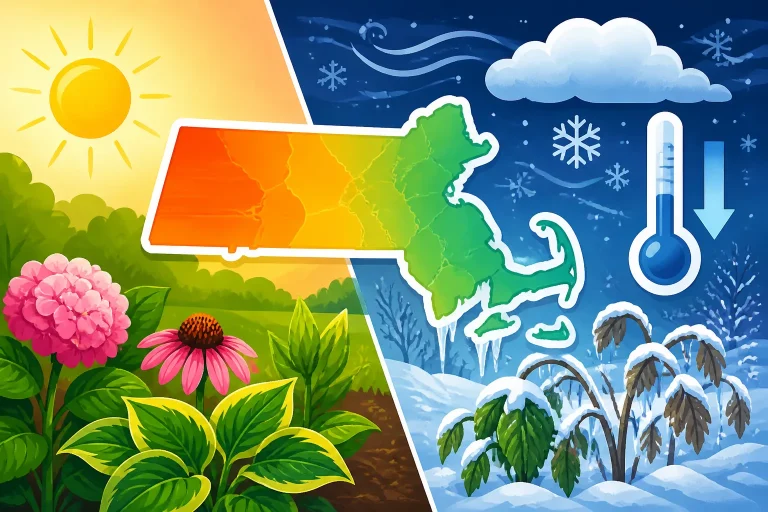
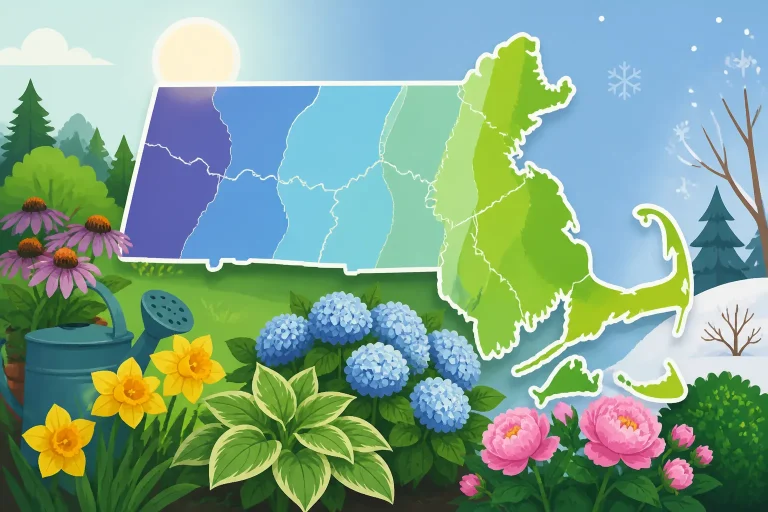
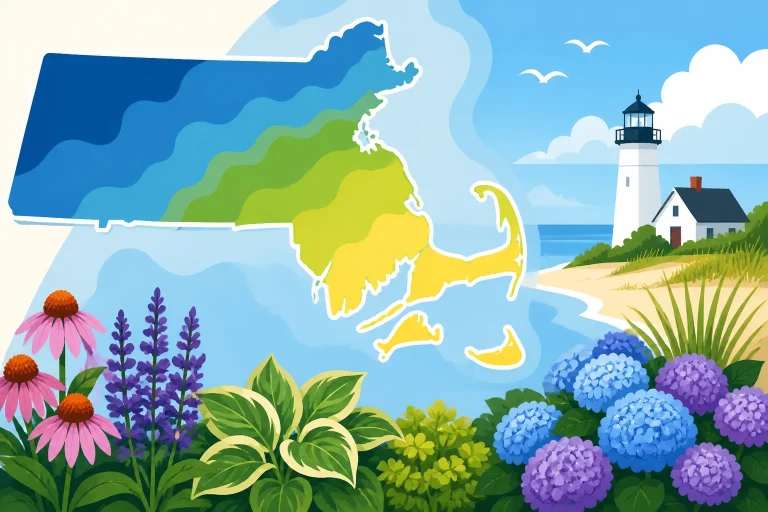
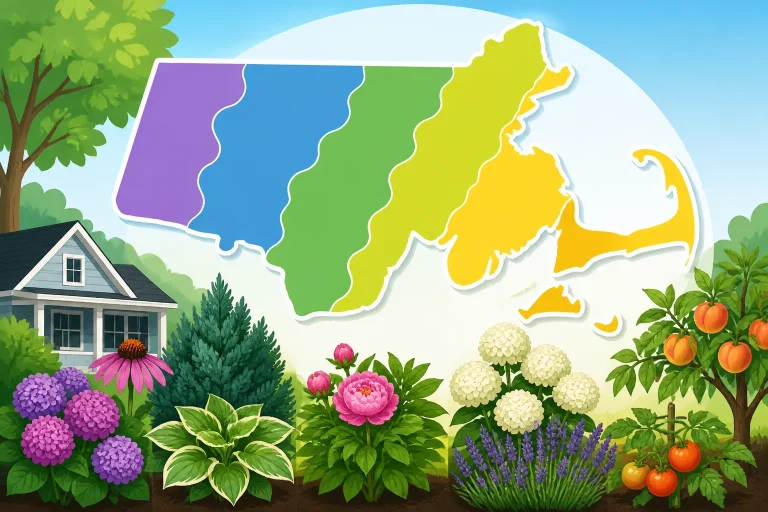
Massachusetts areas fall in zones 5b to 7b on the USDA Plant Hardiness Zone Map. That range is wide enough to matter when choosing plants. A perennial suitable for a milder coastal location may be a less reliable choice in a colder inland or higher-elevation site. Even within a single town, conditions can differ between a sheltered neighborhood and an exposed hilltop.
A plant label’s hardiness zone is usually a clue about its ability to survive winter cold, not a promise that it will grow well in every garden within that zone. The label does not account for whether a plant’s roots are sitting in waterlogged soil, whether winter winds dry out its foliage, or whether an early warm spell causes it to break dormancy before a cold snap. Nor does it tell you whether the plant gets enough sun or has the right soil conditions.
The zone also does not describe the length or quality of the growing season. Two sites may fall in the same zone but differ in spring soil warmth, summer heat, rainfall, and the timing of autumn freezes. Those differences can affect annual vegetables and flowers as much as, or more than, a winter hardiness rating.
That distinction is especially important in a state where the climate changes over relatively short distances. Coastal air can moderate some temperature swings, while inland areas and higher elevations can experience different patterns. Buildings, tree cover, slopes, and low spots create smaller variations within neighborhoods. A ZIP-code result cannot capture every one of these conditions.
For a more complete picture, pair zone information with local freeze records and practical observations from your property. Finding Your Massachusetts Hardiness Zone by ZIP Code helps identify the broad winter-cold category; Massachusetts Frost Dates and Freeze Probabilities: A Station Guide explains why spring and fall freeze timing needs a separate look.
What the zone does not tell you
Hardiness zones are often treated as if they were all-purpose gardening calendars. They are not. A zone can help you compare a plant’s winter tolerance with the typical winter cold in a region, but it does not specify when to sow seeds, transplant vegetables, or expect the last spring frost.
It also does not say that a plant will survive every winter. The map describes a long-term average, not the lowest temperature a particular yard will ever experience. A colder-than-usual winter can put a marginal plant at risk. Conversely, a plant listed for a colder zone may still struggle if its location is exposed, its roots are poorly established, or the soil stays saturated.
A plant’s hardiness rating is best treated as one screening tool among several. Check the plant’s light and moisture needs, mature size, soil preferences, and tolerance for wind or salt exposure. For an edible garden, also consider days to maturity and the crop’s sensitivity to cold. A plant can be winter-hardy as a perennial and still need a long, warm summer to produce well.
How to find your Massachusetts hardiness zone by ZIP code
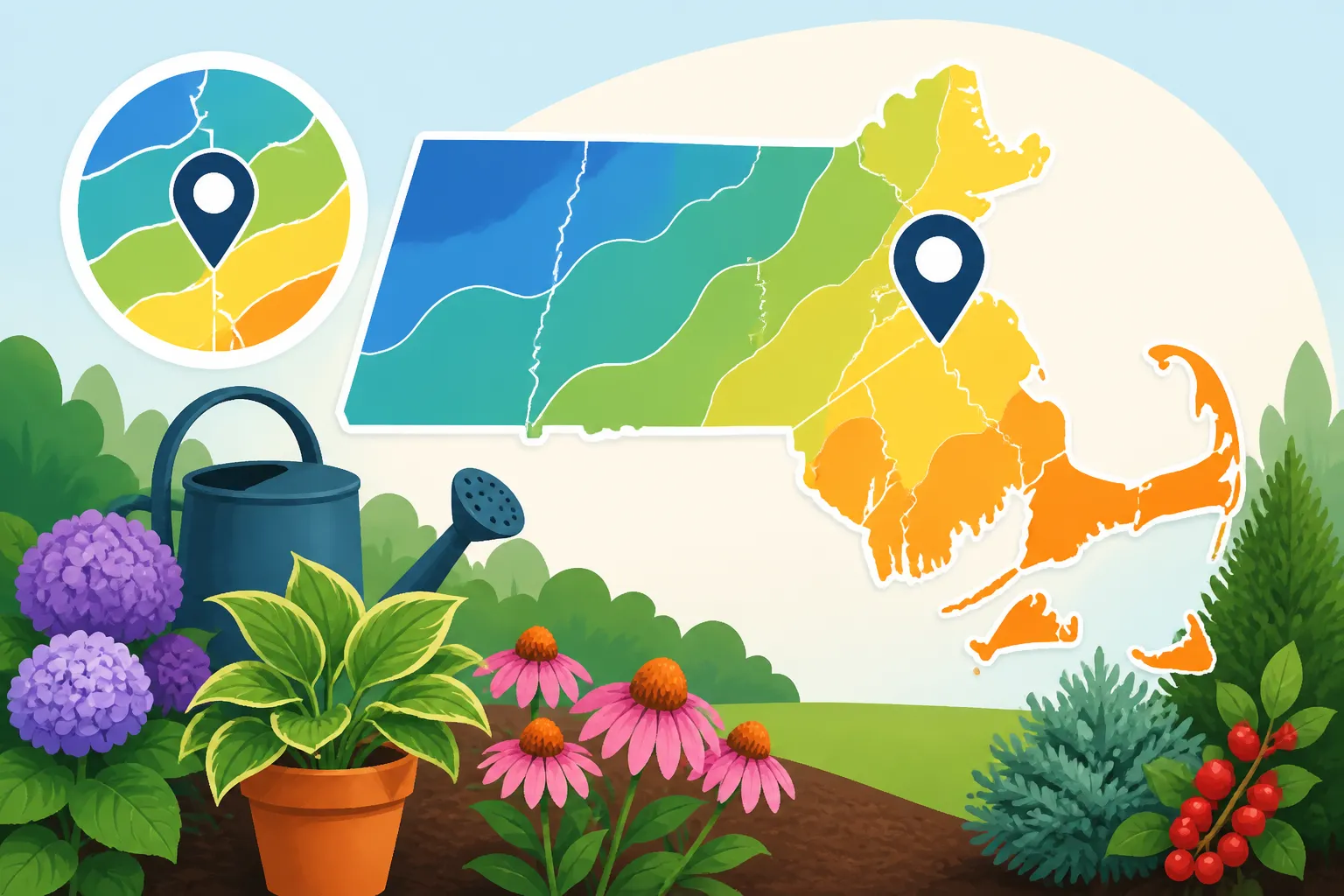
A ZIP-code lookup is a convenient way to get oriented, particularly if you are new to Massachusetts or comparing possible plants before visiting a nursery. Use the USDA Plant Hardiness Zone Map’s official lookup tool or map. Enter your ZIP code, review the result, and treat it as an approximate regional indicator rather than a precise reading for every address within that ZIP code.
A practical lookup process is:
- Enter your ZIP code in the official map’s search tool.
- Note the zone and half-zone shown, if the tool provides one.
- Inspect the map around the search result rather than relying only on the text result.
- Look for a nearby zone boundary, changes in elevation, or a shift from coastal to inland conditions.
- Compare the map result with what you observe in your garden, including winter exposure and recurring cold spots.
- Check the plant label or a reliable plant reference for the plant’s recommended hardiness range.
The map may show more detail than a ZIP-code result alone. If the search result lands near a boundary, zoom in and use the map’s location tool, when available, to inspect the vicinity of your garden. That still will not measure the exact conditions at your home, but it can help you see whether the ZIP-code result represents a broad area or a location close to a zone transition.
Why a ZIP code is not a yard-level climate reading
ZIP codes were created for mail delivery, not to define climate zones. Their boundaries do not necessarily line up with hills, shorelines, valleys, or other climate features. A single ZIP code may cover places with different exposures and elevations, and neighboring ZIP codes can share similar growing conditions.
Map resolution also matters. A color band on a map represents a geographic estimate, not a temperature sensor installed in your garden. Where the terrain changes quickly, a broad map category may not represent every small pocket of colder or warmer air. A digital lookup can make the result feel exact because it returns a zone label, but the label should not be read as a guarantee.
If you garden close to a zone boundary, compare the areas on both sides of it. Think of the boundary as a transition rather than a wall. Plants do not respond to a line on a map; they respond to the temperatures, moisture, wind, and soil conditions around their roots and foliage.
A broader regional view can help you understand why the map looks as it does. Massachusetts Hardiness Zones 5b to 7b: What Your Town Gets gives context for the state’s zone range, while When a Single ZIP Code Spans Different Microclimates addresses the limits of interpreting one ZIP code as a uniform climate area.
How to handle an uncertain result
If the map result seems inconsistent with what you see on your property, do not immediately assume the map is wrong or that your garden is an exception. First, check the location used in the search and look at the surrounding map. Then consider whether your site is exposed, sheltered, elevated, low-lying, close to open water, or surrounded by pavement and buildings.
You can also compare local winter observations over several years. Keep notes about where snow melts first, which beds freeze early, which plants regularly suffer winter injury, and where spring growth begins sooner. One unusually mild or harsh winter is not enough to redefine your site, but a pattern can help you choose a sensible level of caution.
When a plant is borderline for the zone shown, choose a protected planting spot, improve drainage where appropriate, and avoid treating the plant as a sure thing. For a valued plant, it may be sensible to choose one with a wider safety margin or a locally proven alternative. The best choice depends on how much risk you are comfortable taking and how easily the plant can be replaced.
Why Massachusetts gardens can differ from the ZIP-code result
A ZIP code identifies a broad location. Your garden has a smaller climate shaped by landform, nearby water, buildings, vegetation, and exposure. These local variations are called microclimates. They can influence both winter survival and the timing of seasonal growth, sometimes in ways a regional zone cannot show.
Coastal influence and inland exposure
Coastal locations may experience different temperature patterns from inland sites because water changes temperature more slowly than land. That influence is not uniform across the whole coast, and it does not eliminate frost or cold snaps. A garden near the water can still be exposed to strong winds, and a sheltered inland site may sometimes have more favorable conditions than its regional label suggests.
Wind exposure can be a major factor for evergreens and other plants that hold foliage through winter. Cold, dry winds can increase moisture loss from leaves and needles, especially when roots are frozen or the soil is dry. A plant may technically tolerate the zone’s winter low but still show damage on an exposed side of the property. Choosing a protected position or using appropriate winter protection can help, though protection does not change the site’s zone.
Elevation, slopes, and low spots
Elevation and land shape affect how cold air moves. Cold air can settle in low areas, while slopes and elevated sites may have different exposure to wind and sunlight. A low corner of a yard can be noticeably colder than a nearby raised bed, even if both are only a short distance apart.
The direction and steepness of a slope matter too. A sunny, sheltered slope may warm earlier than a shaded or wind-exposed one. That early warmth can encourage plants to start growing sooner, which may increase their vulnerability if cold weather returns. A warm microclimate can be useful, but it is not always safer.
For a landscape planting, check the area at more than one time of day and during different weather. Notice where frost lingers, where water pools after rain, and where wind is strongest. Those observations can explain why a plant succeeds in one bed and struggles in another, even though both spots share a ZIP code.
Buildings, pavement, trees, and garden structures
Walls and paving can absorb and release heat, creating warmer pockets near a building. A sunny south-facing wall may extend the season for some plants, but the same location can expose them to quick temperature swings or encourage early growth. Shade from mature trees can keep a bed cooler and slow spring warming, while also competing for water and nutrients.
Raised beds may warm sooner than the surrounding ground, depending on their construction, exposure, and soil moisture. Containers can be more vulnerable to winter cold than plants in the ground because the roots are surrounded by a smaller volume of soil. A hardy plant that thrives in a garden bed may need additional protection or a more sheltered location when grown in a pot.
These effects are useful when planning, but they should not be mistaken for a permanent zone change. A sheltered nook may help a borderline plant survive, yet a severe cold event can still test it. On the other hand, a colder pocket can make a plant struggle even when the general ZIP-code result suggests it should be suitable.
For more detailed regional context, see Hardiness Zones of Cape Cod and Coastal Massachusetts, Plant Hardiness Zones Across Central and Northeastern Massachusetts, and Hardiness Zones of Western and Northwestern Massachusetts. These regional perspectives are a useful reminder that Massachusetts does not have one uniform gardening climate.
How to use your zone when choosing plants
Once you have a likely zone, use it to filter options, not to make the whole decision. Compare the plant’s stated hardiness range with the zone shown for your area. If your zone falls within that range, the plant may be a reasonable candidate, but you still need to check its growing requirements and consider the conditions of the exact planting site.
A helpful first-pass comparison looks like this:
| What you are checking | What it helps you assess | What it cannot confirm |
|---|---|---|
| USDA hardiness zone | Whether a perennial may tolerate typical winter cold in the area | Survival in every winter or every yard |
| Plant hardiness range | Whether the plant’s stated cold tolerance overlaps your location | Whether the plant gets suitable sun, soil, and moisture |
| Local exposure | Whether wind, shade, or shelter may increase or reduce stress | A guaranteed change to the regional zone |
| Soil drainage | Whether roots may face persistent wetness or poor aeration | Winter hardiness by itself |
| Frost history | When tender growth may be exposed to freezes | The plant’s ability to survive the coldest winter |
| Days to maturity | Whether an annual crop may have enough growing time | Whether summer conditions will be warm enough for good production |
When the plant’s range overlaps your zone
If a plant is rated for a range of zones that includes your likely zone, it is a candidate for your garden, not an automatic success. Look at the plant’s needs and decide whether your site can provide them. A cold-hardy plant that requires well-drained soil may fail in a wet bed, while a plant that prefers shade may scorch in a sunny, heat-reflecting location.
For a plant whose listed range includes your zone at its colder edge, be more attentive to site selection. A sheltered spot, good drainage, and protection from damaging wind may improve the odds. It may also help to ask local gardeners or nurseries which plants have performed reliably in your area. Local observations add useful detail that a broad rating cannot provide.
If your ZIP code appears close to a zone boundary, consider whether the plant is important enough to justify some risk. For a large investment or a plant you want to keep for many years, selecting a more cold-tolerant option may be the safer choice. For a small trial planting, testing a borderline plant in a protected location may be reasonable.
When the plant is listed for a warmer zone
A plant rated only for warmer zones is less likely to withstand typical winter cold in a colder area. A warmer microclimate may reduce stress, but it does not erase the risk. Planting close to a sheltered wall, using winter protection, or growing the plant in a movable container may help in some cases, but none of these approaches guarantees survival.
Before relying on protection, consider how much attention it requires and whether it can be maintained through winter. Some plants need more than a cover: they may be sensitive to wet soil, repeated freeze-thaw cycles, or winter wind. If the plant is valuable and marginally hardy, consider whether you are prepared to replace it after a difficult winter.
It can be more dependable to choose a plant rated for conditions at or colder than your likely zone, especially for a permanent landscape feature. That does not mean you must avoid every borderline plant. It means the decision should be deliberate, based on the site and the level of winter risk you accept.
Annuals and vegetables need a different set of checks
Many annual flowers and vegetables are grown for one season, so winter survival is not the main issue. For these plants, soil temperature, frost sensitivity, days to maturity, and the length of the local growing season may matter more than the hardiness zone. A zone label alone will not tell you when it is safe to plant tomatoes, beans, or other warm-season crops outdoors.
Cold-tolerant crops may handle cool conditions better than heat-loving crops, but even cool-season plants have limits. The planting calendar should reflect local spring and fall conditions, rather than simply following the zone number. Massachusetts Vegetable Planting Guide: Schedules by Region and Massachusetts Planting Calendar: From Spring Thaw to Fall Freeze provide a more useful framework for timing edible crops.
For seedlings started indoors, the date you plan to move them outside depends on the crop and conditions. They need a gradual transition to outdoor light and weather, and tender plants should not be set out solely because a zone lookup suggests the growing season has begun. Hardening Off Indoor Seedlings Before Spring Garden Transplanting explains how to prepare young plants for that change.
Why a hardiness zone is not a planting calendar
A hardiness zone focuses on winter minimum temperatures, while a planting calendar deals with seasonal timing. The distinction matters in Massachusetts because spring frost risk and autumn freezes vary by location and year. A ZIP-code zone cannot tell you the safest week to plant a particular crop.
A zone may be useful for deciding whether a perennial is likely to survive winter, but it does not identify the last spring frost date. Frost dates are estimates based on historical probabilities, not fixed days. Even a local station record is a guide to risk, not a forecast for every yard. A cold pocket, an exposed garden, or a warm urban block may differ from the station conditions.
For tender vegetables and flowers, timing should account for the plant’s cold sensitivity, recent weather, soil warmth, and the forecast. A warm spell can make an early planting feel safe, but temperatures may fall again. The reverse is also true: a cool spring can delay planting even when the calendar suggests the usual window has arrived.
The same principle applies in fall. The first frost date is not a hard stop for every crop. Some vegetables tolerate cool weather or light frost, while others are damaged by temperatures that barely affect hardier crops. Protection can sometimes extend harvests, but the choice depends on crop, weather, and the structure used.
Use these tools together:
- Use the hardiness zone to screen perennial plants for winter cold tolerance.
- Use local freeze probabilities to understand seasonal frost risk.
- Use soil temperature and crop guidance for direct-sowing warm-season vegetables.
- Use the plant’s days to maturity to assess whether an annual crop has enough time.
- Use your own garden observations to account for sheltered and exposed areas.
For a deeper look at why state-wide averages are inadequate, see Why Massachusetts Has No Single Statewide Frost Date. Gardeners planning around spring planting can also use Planning Massachusetts Sowing Around Spring Freeze Probabilities and Calculating Safe Spring Planting Dates from Freeze History. These resources address timing concerns that a zone map cannot solve.
Match the tool to the decision
Before looking at a map or calendar, ask what decision you are trying to make. If you are choosing a flowering shrub that will remain outdoors year after year, winter hardiness is important. If you are deciding when to transplant basil, spring cold risk and the plant’s sensitivity matter more. If you are planning a fall vegetable bed, the crop’s maturity time and the likely harvest window deserve attention.
This simple distinction prevents a common mistake: treating a zone number as a universal planting instruction. A zone lookup can help you rule out some poor perennial choices, but it is not a substitute for crop-specific timing or site assessment.
In practice, the most reliable plan combines several kinds of information. Use the map to establish a regional baseline, then check the relevant planting guidance and adjust for your garden’s microclimate. If the sources seem to disagree, look at what each one measures. One may describe winter cold tolerance, another frost probability, and another soil warmth. They are answering different questions.
A practical way to plan with your ZIP-code result
A useful zone lookup should lead to a better planting decision, not a false sense of precision. Use the following routine when selecting a plant or planning a garden bed.
- Find the broad zone. Search your ZIP code on the official USDA Plant Hardiness Zone Map and note the result. If the map lets you zoom or use a location marker, inspect the area around your garden.
- Check for nearby boundaries. If a boundary is close, treat the result as approximate and compare the surrounding map colors. Do not assume the boundary forms a sharp climate divide.
- Identify the kind of plant. For a perennial, compare its hardiness range with the likely zone. For a vegetable or annual, check frost sensitivity, soil warmth needs, and maturity time instead of relying on zone alone.
- Evaluate the planting spot. Note sun, shade, wind, slope, drainage, nearby buildings, and whether the area is a low spot where cold air or water collects.
- Choose your risk level. For a permanent or expensive plant, consider a wider safety margin. For a low-cost trial, a sheltered planting may be worth testing if you are comfortable with possible winter loss.
- Use the right timing information. Check local frost probabilities and crop-specific planting guidance before sowing or transplanting. Do not treat an average frost date as a guaranteed safe date.
- Keep notes. Record plant survival, winter damage, frost pockets, and spring growth. Over time, these observations help refine your choices within the broad zone shown on the map.
Keep a simple site record
A few notes can turn a general map result into more useful information for your own property. Record the plant name, planting location, sun exposure, soil drainage, and whether it suffered winter damage. Note whether the plant was young or established, since a new planting can be more vulnerable than one with a developed root system.
Record the conditions around a problem rather than simply writing “winter kill.” Did the soil stay wet? Was the plant exposed to wind? Did foliage dry out? Did the plant begin growing during an early warm period? These details can point to a cause other than the zone itself and may suggest a change in placement or care.
Do not overreact to one season. Winter injury can result from a combination of cold, wind, wet soil, drought, and plant health. A single failure does not necessarily prove that the zone lookup was inaccurate. Look for patterns across seasons and across plants.
Consider both survival and performance
A plant may survive winter but still perform poorly. It might flower inconsistently, produce less fruit, or make little new growth because the site is too exposed or the growing season is not a good match. Hardiness asks whether a plant can tolerate winter cold; it does not measure whether the plant will be attractive, productive, or easy to maintain.
This is particularly important when planning a landscape around plants that are near the edge of their recommended range. A plant that merely survives may not meet your expectations. For a low-maintenance planting, locally reliable species and cultivars can be a better fit than marginal choices that need repeated protection.
Likewise, a plant’s rating does not replace checking for local issues such as drainage, deer browsing, road salt, or shade. If those site conditions are wrong, choosing a plant with a suitable zone rating will not solve the underlying problem. Start with the site, then use the zone to refine the shortlist.
When to seek local confirmation
If a high-value landscape planting or a long-term garden design depends on a borderline choice, confirm the plant’s suitability with a knowledgeable local nursery or horticulture professional. Ask about performance in conditions similar to yours, not just whether a plant is sold locally. A plant may be offered for sale even if it needs a protected location or extra care.
When comparing advice, be specific about your site. Mention whether it is coastal or inland, exposed or sheltered, sloped or low-lying, and whether the soil drains well. “What grows in my ZIP code?” is a useful starting question, but “Will this plant tolerate a windy, wet bed with afternoon shade?” is more likely to produce an answer that fits your garden.
A ZIP-code hardiness result is most valuable when it is combined with that kind of detail. It can narrow the choices, but your property and the plant’s needs determine whether the match is practical.
Frequently Asked Questions
Can I get an exact hardiness zone from my Massachusetts ZIP code?
A ZIP-code lookup can provide a useful regional estimate, but it cannot define the conditions in every yard within the ZIP code. Check the map around the search result and account for nearby zone boundaries, elevation, exposure, and other microclimate effects.
Does my hardiness zone tell me when to plant vegetables?
No. The zone describes average winter cold and is mainly used to assess perennial winter hardiness. Vegetable timing depends on crop sensitivity, frost risk, soil temperature, and the time the crop needs to mature.
If a plant is listed for my zone, will it definitely survive?
No. A suitable rating means the plant may tolerate typical winter cold for that zone. Severe weather, poor drainage, wind exposure, plant health, and other site conditions can still cause damage or loss.
Should I choose a plant rated for a colder zone than my ZIP-code result?
That can provide a larger winter-hardiness margin, especially for permanent or valuable plantings, but it is not the only factor. Check the plant’s light, soil, moisture, and exposure needs, and consider whether it has performed well in conditions like yours.
Disclaimer
This article is for general informational purposes only and does not constitute professional advice. Laws, prices and regulations vary by location and change over time. Consult a qualified professional for guidance on your specific situation. Massachusetts Gardening Guide is not a government agency and is not affiliated with any university extension, state department of agriculture or other government agency.