Massachusetts Hardiness Zones 5b to 7b: What Your Town Gets
Massachusetts gardeners often find that a hardiness-zone map gives a useful starting point but not a clear planting date—or a guarantee that a plant will thrive. The state spans zones 5b to 7b, and conditions can vary within a town. Here’s how to check the zone for your area and use it alongside local frost patterns, exposure, and growing conditions.
What hardiness zones 5b to 7b mean
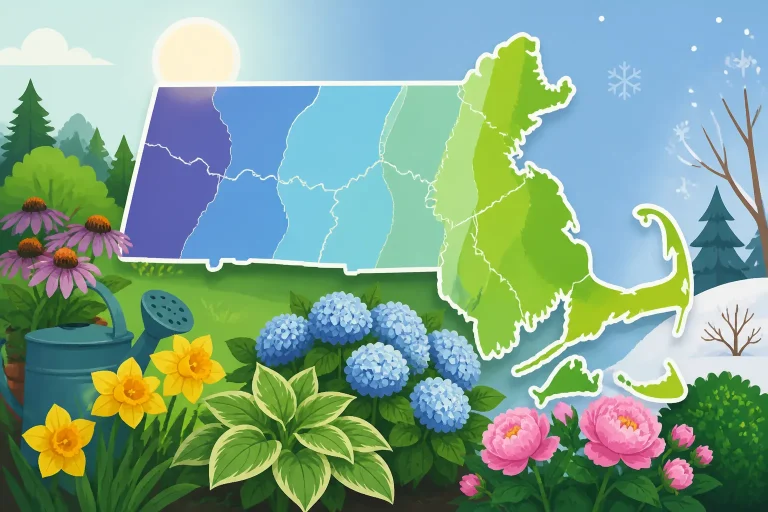
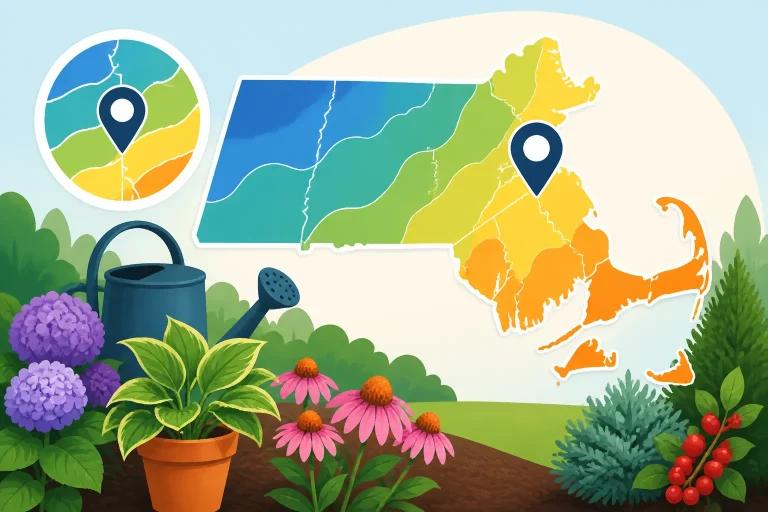
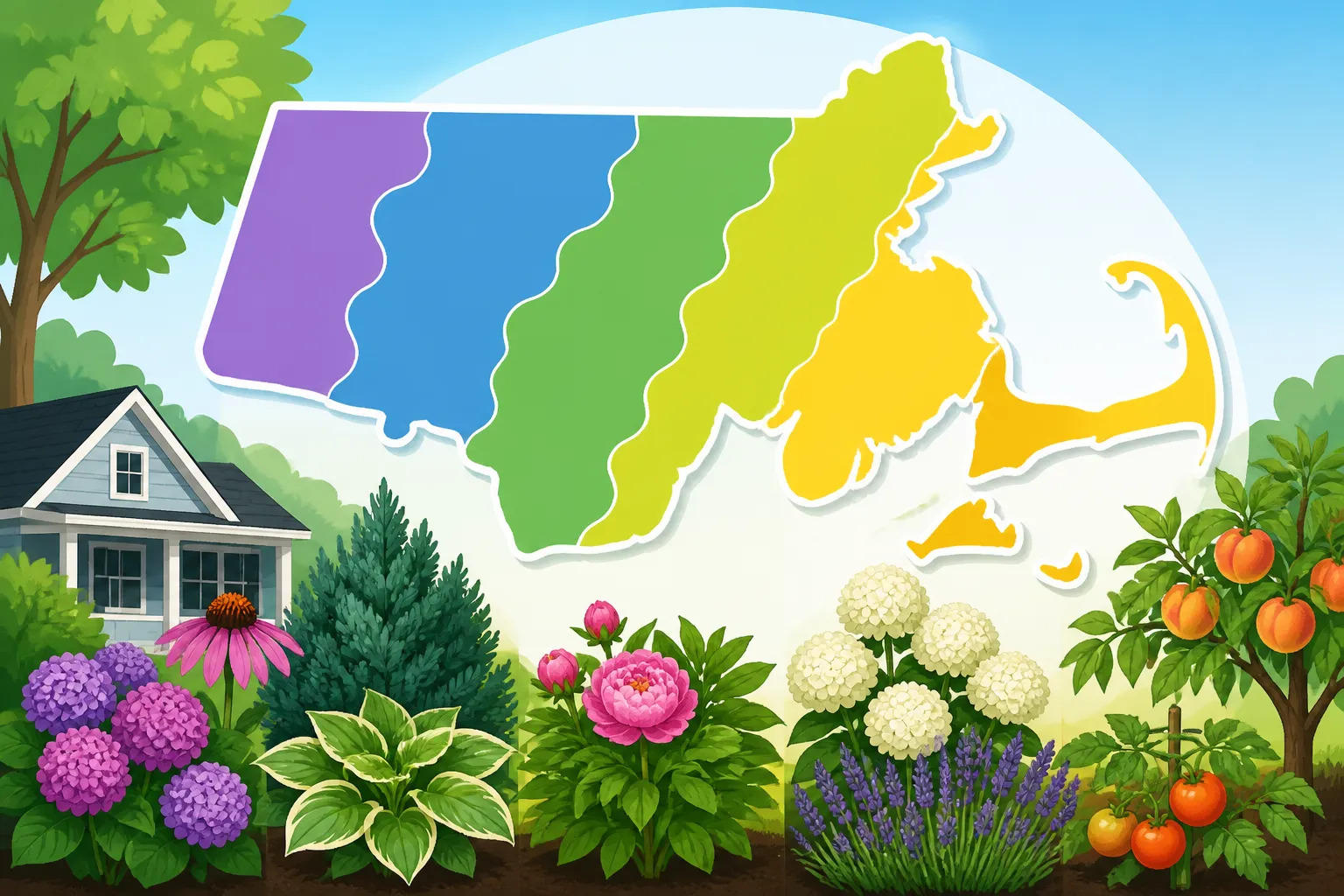
The USDA Plant Hardiness Zone Map groups areas by their average annual extreme minimum winter temperature. The number and letter identify a temperature band: the number marks a broader zone, while “a” and “b” split it into smaller bands. Zones 5b to 7b are part of the range relevant to Massachusetts gardeners.
| USDA zone | Average annual extreme minimum temperature range |
|---|---|
| 5b | -15°F to -10°F |
| 6a | -10°F to -5°F |
| 6b | -5°F to 0°F |
| 7a | 0°F to 5°F |
| 7b | 5°F to 10°F |
These ranges describe a long-term average of the coldest temperature recorded each year, not the coldest temperature a place can ever experience. A garden in zone 6b can still have an unusually cold winter. The zone is a way to compare winter cold patterns, not a promise that every winter will stay within the listed range.
The zone label is useful when evaluating whether a perennial, shrub, or tree is likely to survive typical winter lows in a location. If a plant is rated for zones 5 through 8, for example, its listed range includes the Massachusetts zones shown above. That rating does not tell you whether the plant will thrive in your soil, get enough sun, tolerate wet roots, or produce a good crop. Those factors matter too.
The boundaries on the map are not lines between places with completely different climates. A nearby area in an adjacent half-zone may have only a modest difference in its long-term winter minimums. Conditions in a particular yard can also differ from the map because of slope, shade, wind exposure, elevation, buildings, and other local features.
For more detail on the broader Massachusetts range and how zones are distributed around the state, see Massachusetts Hardiness Zones 5b to 7b: What Your Town Gets. For the practical process of checking an area, Finding Your Massachusetts Hardiness Zone by ZIP Code can help you interpret what the map shows. ZIP codes or areas fall in a zone on the USDA Plant Hardiness Zone Map; a ZIP code is a useful starting point, not a guarantee that every yard within it has identical conditions.
Why your town may not have one single zone
A town’s name is often too broad to tell you exactly what winter conditions to expect in your garden. Map zones represent geographic areas, not municipal boundaries. A town may include low ground, hillsides, exposed ridges, shaded neighborhoods, and built-up areas, all of which can experience different conditions.
Even when the map gives a single zone for much of a town, individual gardens may behave differently. A sheltered yard beside a building may hold warmth better than an open, windy site. A south-facing slope may warm earlier in spring than a north-facing one. Cold air can settle in low spots, so a garden at the bottom of a slope may be more exposed to frost than a nearby garden higher up.
These differences are often called microclimates. They can affect plant survival, the pace of spring growth, and the timing of frost damage. A microclimate does not change the official zone shown for the area, but it can change what a gardener observes in a particular bed. When a Single ZIP Code Spans Different Microclimates explains why one ZIP code can contain several distinct growing conditions.
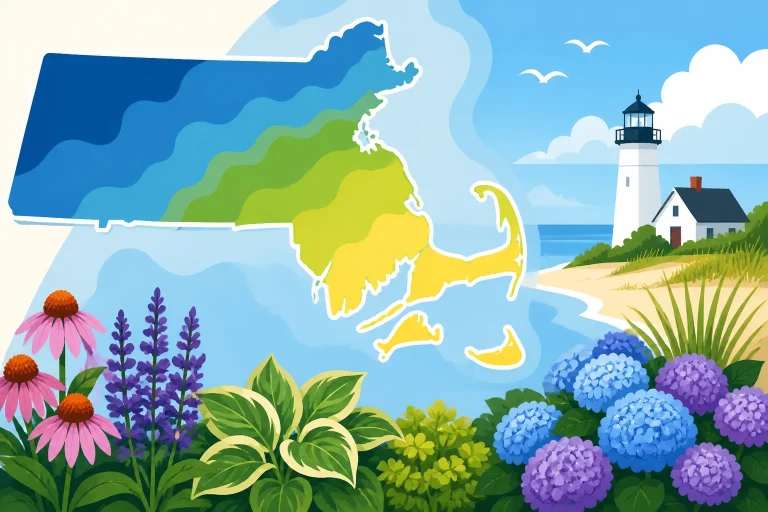
Coastal and inland locations can also differ. Near the coast, surrounding water can moderate some temperature swings, while inland sites can experience different patterns of cold and seasonal change. Within the state, local terrain and exposure add further variation. That is one reason a statewide zone label should be treated as a starting point rather than a complete planting plan. Massachusetts Planting Differences: East and South vs West offers more context on regional variation, and Hardiness Zones of Cape Cod and Coastal Massachusetts looks specifically at coastal conditions.
When you look up your area, check the map at the most useful level it allows, then compare it with what you know about your property. Ask practical questions: Does cold air collect in the yard? Is the planting bed sheltered from winter winds? Does a slope face south or north? Does the site remain damp after snowmelt or rain? These observations will not replace the zone map, but they can help you make better choices within it.
A map lookup should not be treated as an exact prediction for an address. Instead, use it to narrow down the likely zone range for your area. If a garden lies close to a zone boundary, or if a property has unusually exposed or sheltered conditions, it is sensible to be cautious with plants that are marginal for the colder nearby zone.
What a hardiness zone does and does not tell you
Hardiness zones are most useful for evaluating a plant’s ability to tolerate winter cold. They are less useful for answering questions about spring planting dates, the length of the growing season, summer heat, soil conditions, or the likelihood of a late frost.
A plant that is hardy in a particular zone may survive winter there, but survival and performance are not the same thing. A plant can make it through winter and still struggle because of poor drainage, insufficient light, drought, pests, or a mismatch with the site. A zone rating also does not promise that flowers, fruit, or vegetables will mature before autumn cold arrives.
For annual vegetables, winter hardiness is rarely the main decision point. Many garden vegetables are planted for a single growing season and cannot tolerate freezing temperatures, even in a relatively mild zone. Their planting dates depend more on soil warmth, frost risk, the crop’s tolerance of cool conditions, and the time it needs to mature. A zone map can give background on the climate, but it cannot tell you when to sow beans or transplant tomatoes.
Frost dates answer a different question from hardiness zones. A frost-date estimate is based on the likelihood of a freeze at a particular station or location. It is a probability, not a fixed day that applies to every garden. Dates and risks can differ across Massachusetts, and local terrain can make a yard colder or warmer than the nearest station suggests. For a closer look at station data and probabilities, use Massachusetts Frost Dates and Freeze Probabilities: A Station Guide.
The difference matters in spring. A plant may be capable of surviving the typical winter low for its zone but still be damaged by a late spring freeze after new growth has emerged. Likewise, a warm spell can prompt tender growth before the risk of cold has passed. A warmer zone does not remove the possibility of a sudden cold snap; Why a Warmer USDA Zone Does Not Prevent Sudden Cold Snaps explains why gardeners should keep winter hardiness and short-term weather risk separate.
The same distinction applies in autumn. A zone label cannot predict the date of the first frost in a particular year. Some crops tolerate cool weather and can continue producing after a light frost, while tender crops may be damaged. The useful question is not just “What zone am I in?” but also “How much time does this crop need, and what kind of cold can it tolerate?”
Use the following comparison to decide which information to check for a specific garden question:
| Garden question | Most useful information |
|---|---|
| Is a perennial or shrub likely to survive typical winter lows? | The plant’s hardiness rating and your local zone |
| When might spring frost occur? | Local frost probabilities and current forecasts |
| When can warm-season crops go outdoors? | Frost risk, soil warmth, and the crop’s needs |
| Why does one bed stay colder than another? | Site exposure, slope, drainage, and microclimates |
| Will a vegetable mature before autumn cold? | Days to maturity, planting window, and likely fall conditions |
Using your zone to choose plants
Start with the plant’s listed hardiness range and compare it with the zone for your area. A plant rated to tolerate colder conditions than your zone is generally a less risky choice for winter survival than one rated for warmer zones only. If the rating just touches the local range, look more carefully at the planting site and the plant’s other needs.
For example, a plant at the edge of its hardiness range may be a poor choice for a windy, exposed site but more plausible in a sheltered location with good drainage. That does not guarantee success; it helps identify where winter stress may be greater. Similarly, a plant’s winter tolerance does not mean it will handle standing water, drought, or summer heat.
When comparing plant listings, check whether the hardiness information refers to USDA zones and read the full range rather than relying on a single number. Be alert to ratings that describe a plant as hardy in a warmer zone but do not include the colder edge of Massachusetts’ zone range. If the plant is important to your design, consider whether you can provide a suitable site and protection, or choose a plant with a wider margin for local winter conditions.
For trees and shrubs, site fit is especially important because they remain in place for many years. Before choosing, consider mature size, sunlight, soil moisture, drainage, and exposure in addition to the hardiness rating. A tree suited to a shaded, moist area may not be a good match for a hot, dry bed, even if its zone range appears suitable. The same principle applies to perennials: the right zone is one piece of a broader site match.
For vegetables, treat the zone as background rather than a planting schedule. Cool-season crops and warm-season crops respond differently to soil temperature and frost. A calendar based on regional conditions, plus observation of your garden, is more useful for deciding when to sow and transplant. Massachusetts Planting Calendar: From Spring Thaw to Fall Freeze provides a seasonal framework, while Massachusetts Vegetable Planting Guide: Schedules by Region can help connect crop timing with regional differences.
It can also help to keep notes. Record where tender plants fare well, which beds thaw first, and where frost damage appears. A few seasons of observation can reveal reliable patterns: perhaps one corner stays cold, or a sheltered bed warms early. These records do not alter the official map zone, but they make it easier to match future plant choices to your property.
A practical way to check what your town gets
Use a short sequence rather than relying on a town label alone:
- Look up the area on the USDA Plant Hardiness Zone Map. Use the map to identify the zone shown for the relevant part of town. If the area is close to a boundary, note the neighboring zone as a possibility rather than treating the line as a sharp climate divide.
- Check whether your ZIP code covers varied terrain. A large or geographically varied ZIP code can include more than one local setting. Compare the map with the actual location of the garden, and keep in mind that ZIP codes or areas fall in a zone on the map rather than receiving a guaranteed zone for every address.
- Assess the garden itself. Note whether the site is exposed to wind, shaded, near a building, low-lying, or on a slope. Look for places where cold air may collect and for beds that drain slowly.
- Match the zone to the plant’s purpose. For a perennial or woody plant, compare its hardiness range with the area’s zone. For vegetables, check frost risk, soil warmth, and the time needed to mature.
- Use local frost information for planting decisions. Hardiness zones do not give planting dates. Consult regional frost probabilities and current conditions before putting tender crops outdoors.
- Reassess from your own observations. Keep track of winter injury, spring frost damage, and how quickly different parts of the garden warm. Use those patterns to refine future choices without assuming that one unusually mild or cold season changes the zone.
This approach is especially useful when a map lookup gives a result close to a zone boundary, when a town contains varied terrain, or when a plant is only just hardy enough for the listed zone. It avoids two common mistakes: treating an entire town as though it has one uniform climate, and treating the zone label as a planting calendar.
The key is to use each kind of information for the question it can answer. A hardiness zone helps assess typical winter cold. Frost records and forecasts help manage near-term freeze risk. Soil and site observations help you decide whether a particular bed suits the plant. Together, these give a more useful picture than the town name alone.
Frequently Asked Questions
Does every address in a Massachusetts town have the same hardiness zone?
No. A town may include different terrain and exposures, and map zones do not necessarily follow town boundaries. Use the map for the area and consider the conditions in your specific garden.
Does zone 7b mean a garden will never get colder than its zone range?
No. The range reflects an average of annual extreme minimum temperatures over time. An individual winter can be colder, and local conditions can differ from the map.
Can I use my zone to decide when to plant vegetables?
Not by itself. Vegetable planting depends on crop type, frost risk, soil warmth, and time to maturity. Use a regional planting calendar and local conditions alongside the zone.
Is a warmer zone always better for gardening?
Not necessarily. A warmer zone may indicate milder average winter lows, but it does not guarantee suitable soil, enough moisture, a long frost-free season, or protection from sudden cold.
Disclaimer
This article is for general informational purposes only and does not constitute professional advice. Laws, prices and regulations vary by location and change over time. Consult a qualified professional for guidance on your specific situation. Massachusetts Gardening Guide is not a government agency and is not affiliated with any university extension, state department of agriculture or other government agency.